
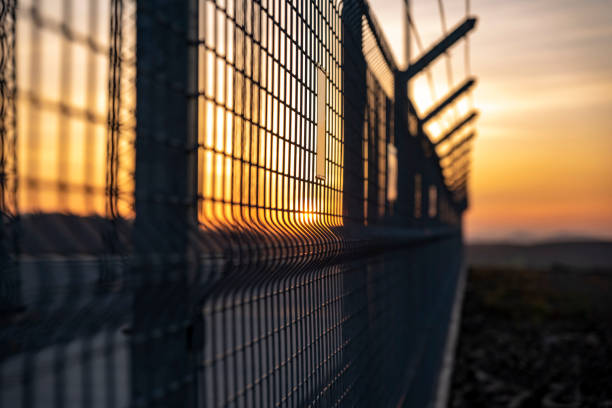
A perimeter is difficult to breach when it removes easy choices. Intruders often look for the lowest effort route: a section hidden from view, a gate that does not close properly, a low point beside a retaining wall or an object that can be used as a step. Strength matters, but strength alone does not determine performance. A reliable boundary combines physical resistance with visibility, controlled openings and consistent maintenance.
Continuity is one of the most important features. Every transition should be checked because attackers are more likely to exploit an easier junction than challenge the strongest central section. A strong fence section loses value if it meets a building, wall or gate in a way that leaves a simple bypass. Corners, changes in level and service openings deserve particular attention because they interrupt the regular line. Drainage channels, pipe routes and gaps beneath gates can also become access points if they are not considered during design. The perimeter should be reviewed as a complete loop rather than as separate products installed next to one another.
Height can increase the effort required to climb, but surrounding features affect the effective height. A low roof, parked trailer, storage rack or embankment beside the boundary can shorten the climb dramatically. Keeping movable items away from the fence where practical helps preserve its intended function. The same principle applies outside the property, although a site owner may have less control over neighbouring objects or changes in ground level.
Material and construction influence how long a barrier can resist cutting, bending or forcing. Selection should reflect the type of threat and the environment. Coastal exposure, heavy vehicle movement or frequent public contact may affect durability and maintenance needs. The security fencing should be robust enough for its purpose, but an unnecessarily severe specification can add cost without addressing the most likely vulnerability elsewhere on the site.
Gates are often the point where security and operation meet. They must open frequently enough to support the business, yet close reliably when access is not authorised. Hinges, locks, automation and ground clearances all deserve attention. A wide vehicle gate that remains open while several deliveries arrive may create a larger exposure than the rest of the perimeter combined.
Observation adds another layer. A person is more likely to be noticed when sightlines are clear, lighting is appropriate and cameras cover the approach rather than only the building. Dense planting or solid panels can create privacy, but they may also provide concealment. The layout should balance these needs.
Detection becomes more useful when there is a practical response. Cameras, alarms or sensors can identify activity, but the site still needs a clear process for what happens next. That may involve a control room, security provider, staff procedure or escalation plan. Physical delay gives that response time to work. In this sense, security fencing contributes by slowing progress and directing movement rather than acting as a complete solution by itself.
Maintenance protects that delay. Corrosion, loose panels, damaged locks, vegetation growth and erosion can all create weaknesses gradually. If defects remain obvious, they may signal that the perimeter is rarely checked. Regular inspections should focus on changes as well as damage, including new objects placed near the boundary or alterations to access routes.
A difficult perimeter to breach is therefore not defined by one intimidating feature. It is a system with no obvious weak transition, no neglected opening and no easy route created by surrounding conditions. The strongest result comes from combining continuous physical barriers, sensible gate control, visibility and prompt maintenance. When each layer supports the others, security fencing becomes part of a perimeter that requires more time, effort and exposure to overcome.